


About the webinar
On 10 and 11 March 2026, the LiveSeeding project organised the III EU LiveSeeding Webinar on boosting organic seed and plant breeding entrepreneurship, titled “Governance and Finance Models for Organic Seed and Plant Breeding in Europe”. Held online, the event brought together more than eighty participants from across Europe, including breeders, seed producers, researchers, policy officers, and representatives of civil society organisations. Twelve speakers and moderators contributed over the course of two days.
The webinar is part of the LiveSeeding Organic Seed and Breeding Entrepreneurship Training Centre, which has among its activities four EU-level online training webinars. It aimed to provide participants with practical insights and strategic tools to:
- Understand and contrast different governance and financing models currently applied.
- Explore a wide range of public and private financing schemes.
- Learn directly from organic seed and plant breeding real-life experiences.
Opening
The training event was coordinated and opened by María Carrascosa, Project Manager at the Spanish City Network for Agroecology (Red de Municipios por la Agroecología) and agronomist specialising in agroecology, food policies, and cultivated biodiversity.
After presenting the LiveSeeding project, she conducted a Mentimeter poll that offered a snapshot of the audience. More than eighty participants joined the first session, representing over fifteen European countries, with France, Germany, Greece, Spain, and Belgium among the most represented. The participant community spanned a wide range of stakeholder groups: researchers made up the largest share (46%), followed by NGOs (22%), organic breeders (30%), and national, regional or local authority representatives (11%), with organic seed producers, conventional breeders, seed suppliers, and conventional seed producers also present. When asked what they hoped to learn from the webinar, participants most frequently mentioned governance models, ideas on financing organic plant breeding, practical experience from other initiatives, and insights into how other organisations work — expectations that the two-day programme was well placed to address.
Governance Models for Organic Seeds and Plant Breeding in Europe
LiveSeeding analysis of governance models
The first session opened with a presentation by Mariateresa Lazzaro, Scientific Co-coordinator of the LiveSeeding project and co-leader of the Organic Plant Breeding Group at FiBL Switzerland. Drawing on the project’s analysis of sixteen organic plant breeding (OPB) initiatives across Europe (LiveSeeding Deliverable D5.2), Lazzaro offered a structured overview of the governance landscape. Key findings included:
- Of the sixteen initiatives analysed, only three are exclusively dedicated to plant breeding; the majority combine breeding with seed production and other activities.
- Most initiatives have grassroots origins and emerged from the organic seed movement, which strongly shapes their governance cultures and decision-making logics.
- Governance structures vary considerably in formality: from highly informal family-based arrangements to structured boards with multi-stakeholder representation, including farmers, processors, and research institutions.
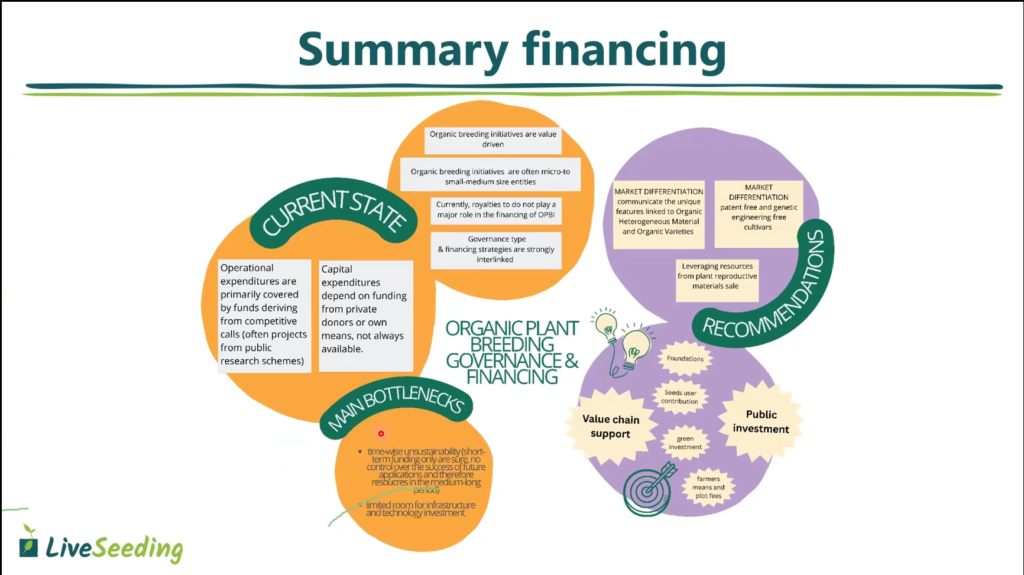
- Royalties play a very limited role in financing OPB initiatives, accounting for approximately 5% of total sales on average, and only becoming relevant where initiatives hold significant market share — a situation uncommon for most OPB initiatives.
- A stronger interlink between breeding activities and plant reproductive material sales is identified as a structural priority for the sector.
Operationalising governance models in day-to-day practice
A panel moderated by Kostas Koutis, Director of AEGILOPS (Greece), brought together three contrasting initiatives to explore how governance models operate in practice: Romain Schaetzel, Director of Union Bio Semences (France), Grietje Raaphorst-Travaille, organic breeder and seed producer at Nordic Maize Breeding (The Netherlands), and Federica Bigongiali, Director of Fondazione Seminare il Futuro (Italy).
Key insights from the discussion:
- Governance models are closely shaped by organisational size. Nordic Maize Breeding, a family enterprise in the Netherlands, makes decisions in an agile manner. Union Bio Semences, a union of two cooperatives with ten farmer board members and ten staff, operates through a structured strategic and operational division. Fondazione Seminare il Futuro, an Italian non-profit, concentrates operational decisions in its directorate while strategic lines are set by a board of four members, one of which is a producers’ cooperative.
- A recurring tension across all three models is the boundary between strategic and operational responsibilities. When this boundary becomes unclear, coordination challenges and internal conflicts can emerge — solutions can rely on dialogue, pedagogy, and sustained discussion to reach consensus.
- Collaboration with actors along the food value chain — including millers, pasta makers, retailers, and consumers — is increasingly central to governance, not only to commercial strategy. Governance structures can be designed in an open way to actively facilitate collaboration with consumers and other chain actors.
- Several initiatives noted an emerging need to open and revise their governance structures, particularly to integrate farmers more directly into decision-making processes. This was identified as both an organisational challenge and a strategic opportunity.
Financing Models and Strategies for Organic Seeds and Plant Breeding in Europe
LiveSeeding analysis of financing models
The second day opened with a complementary analysis by Mariateresa Lazzaro focused on financing models across European OPB initiatives based on LiveSeeding Deliverable D5.2. Key findings included:
- Operational expenditure (OPEX) is financed primarily through competitive public funding, while capital expenditure (CAPEX) tends to rely on private donations or own resources — a structural imbalance that limits long-term planning capacity.
- Collaborations between public, private, and civil society actors are essential for financial resilience. Models from Germany and Switzerland were cited as particularly well-developed and potentially transferable to other national contexts. A notable example from Switzerland is a voluntary contribution mechanism managed by Bio Suisse, whereby organic farmers using conventional seed pay the price difference between organic and conventional seed, which is then redirected towards organic plant breeding programmes — a model particularly active in potato seed.
- The most promising pathway identified combines sector-level value chain support with sustained public investment, rather than relying on any single funding stream.
Accessing finance for Small and Medium Sized Initiatives — funding sources, requirements, and pathways
A panel moderated by Caroline Formont, Policy Officer at IFOAM Organics Europe, brought together Gema Canós, Head of the Rural Development Aid Service, Department of Agriculture, Fisheries and Natural Environment of the Government of the Balearic Islands (Spain), Maria Gernert, TP Organics Senior Officer, and Pilar Martínez, Head of the Sustainable Food Programme in Spain of Daniel and Nina Carasso Foundation.
This panel explored the main public and private funding mechanisms available to small and medium-sized initiatives, presenting three complementary perspectives:
- Regional measures of the National CAP Strategic Plans for the promotion of varieties at risk of genetic erosion and genetic resources for food and agriculture: the Government of the Balearic Islands has put in place two measures under this framework. Between the 2015 and 2023 calls, the programme’s budget multiplied fourfold, benefiting farmers and organisations working on the conservation and recovery of local varieties and the prevention of genetic erosion and the loss of agricultural biodiversity. Through these measures, a regional catalogue of landraces has been established, now including 453 varieties from 53 species. Farmers receive around €600 per hectare for cultivating local varieties, subject to a minimum area of 0.3 hectares per variety, while the maximum eligible investment per beneficiary organisation is €100,000. The Balearic case was presented as a replicable model for other regions.
- Horizon Europe opportunities for organic seed and plant breeding initiatives: Consortium-building is key, and TP Organics — the European Technology Platform for Research and Innovation into Organics and Agroecology, hosted by IFOAM Organics Europe — plays an active role in shaping research agendas and facilitating partnership opportunities. SMEs and breeding initiatives are welcome to participate in the platform, where they can contribute meaningfully to Horizon Europe projects beyond dissemination, including in field trial implementation and data generation.
- Private and philanthropic funding: unlike public sources, these are designed to take risks and support innovation. In terms of the type of projects most likely to attract philanthropic support, pilot projects and scaling initiatives rank highest, while advocacy and research are also of growing interest. For OPB initiatives seeking this type of funding, key strategic considerations were highlighted: framing proposals around systemic change and cross-sectoral approaches, emphasising open-source accessibility, and connecting the initiative to priority themes such as organic and regenerative agriculture, biodiversity, and climate change adaptation. Two emerging financing innovations were also mentioned: Payments for Ecosystem Services (PES) by food companies to incentivise biodiversity; and nature and biodiversity credits as economic incentives for ecological restoration.
Strategies to Ensure Financial Sustainability of Organic Plant Breeding organisations.
The last panel, moderated by María Carrascosa, brought together Carl Vollenweider, co-team leader of the Research and Breeding department at Dottenfelderhof (Germany), and David McKeithen, researcher at Bioleft (Argentina), to discuss concrete strategies for ensuring the long-term financial sustainability of OPB organisations. The discussion was structured around three thematic blocks.
On financial strategies, the centrality of diversification was highlighted: no single funding source is sufficient, and combining public funding, private foundations, research projects, in-kind contributions, and sector-specific instruments is essential to build resilience and reduce dependency on any single funding stream. Another key shared insight is that time is intrinsic to plant breeding and financial models must reflect this — building a variety takes years, and short-term income targets are incompatible with the logic of OPB. Two contrasting models were presented: Dottenfelderhof combines a German national seed fund (approximately 20%), research projects, plant variety protection revenues (which can reach up to 15%, but only once varieties are established on the market), and donations from private foundations, valued precisely for their long-term outlook. Bioleft, an organisation working within an open-source seed framework, relies on public and philanthropic funding, training activities, in-kind contributions such as volunteer time, and university infrastructure and labour. Seed sales are not part of their revenue model — on the contrary, Bioleft distributes seed freely to build networks and raise awareness.
Other key factors for financial sustainability and governance emerged: motivation and dedicated people are foundational, particularly in initiatives that began with very limited resources; and associativism and participatory governance are strategic assets, not merely ethical choices. Stable, long-term funding was identified as a key enabler of more participatory governance structures. A structural bottleneck shared across the sector is that salaries in OPB are not competitive, which undermines the capacity to attract and retain talent.
On Plant variety protection (PVP) and open-source (OSS) licences, speakers noted that PVP and OSS models can coexist. But patents are incompatible with the principles of OPB and have negative consequences for innovation. Both speakers acknowledged the existence of grey areas and the need for continued collective reflection on how to navigate the relationship between PVP systems and open-source approaches, and on how to work collectively against the expansion of patents on plant genetic resources. In countries where seed exchange is increasingly restricted by regulation, OSS licences can help make seeds accessible to farmers, serving as practical normative alternatives.
Conclusions
Closing the webinar, María Carrascosa drew together the key threads emerging from both days of discussion. She underscored that there is no single solution for building sustainable organic seeds and plant breeding initiatives — there is still space for improvement and collective reflection, and diverse and complementary strategies need to be put in place.
Several cross-cutting conclusions were highlighted:
- Diversify to strengthen: just as cultivated biodiversity requires diverse seed systems, financial sustainability requires diverse and complementary funding sources and collaborations. The more actors involved in supporting organic plant breeding — from public institutions to philanthropic foundations, from value chains to farmer networks — the more resilient the sector becomes.
- Governance and financing are deeply intertwined: the source of funding affects decision-making processes, priorities, and relationships with farmers and other chain actors. Stable, long-term financing tends to enable more participatory and open governance structures.
- Building participatory governance structures is not only an ethical commitment but a strategic pathway to financial sustainability, as demonstrated by multiple initiatives across both sessions.
- The sector needs continued collective work to understand, document, and strengthen the diverse strategies being deployed to support organic plant breeding, cultivated biodiversity, and farmers’ rights. In particular, common spaces for reflection on the possible complementarities and unique paths for plant variety protection and open-source approaches remain a priority.
You can access all presentations from the webinar on the link.
View the full webinar here:
The next and final EU LiveSeeding Webinar will focus on business models and business plan development, and will take place on 13–14 May 2026. More information here.
Links to previous EU-level online webinars organised within the LiveSeeding Organic Seed and Breeding Entrepreneurship Training Center: