


About the webinar
On 13 and 14 May 2026, the LiveSeeding project organised the fourth and last EU LiveSeeding webinar on boosting organic seed and plant breeding entrepreneurship on boosting organic seed and plant breeding entrepreneurship, titled “Business Models and Business Plans Development.” Held online, the event closed a series of four EU-level training webinars developed within the LiveSeeding Organic Seed and Breeding Entrepreneurship Training Centre, which previously covered entrepreneurship, marketing, and governance and finance models for the sector.
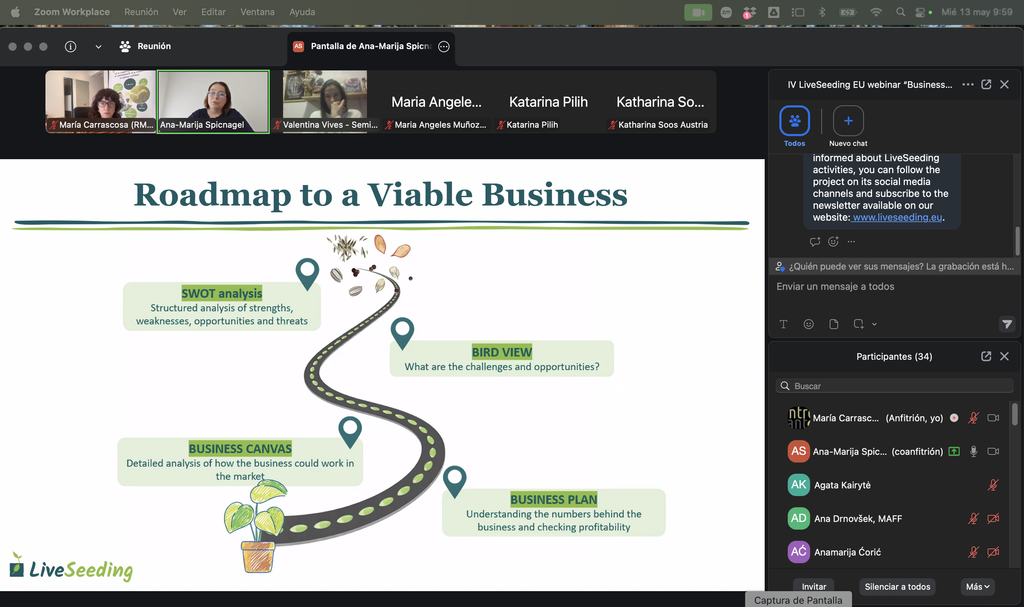
The webinar guided participants, step by step, through a practical Roadmap to Business:
- Business Birdview, a one-page strategic tool connecting challenge analysis with strategic direction.
- Business Model Canvas, to clarify how value is created, delivered and monetised.
- Business Plan, turning strategic ideas into concrete actions, timelines and financial projections.
- An overview of funding sources, with their respective opportunities and limitations.
Each session combined a short introduction to the tool with real-life examples, followed by guided practical work in which participants applied each tool to their own case.
Opening
The webinar was opened on both days by María Carrascosa, Project Manager at the Spanish Cities Network for Agroecology (Red de Municipios por la Agroecología), who coordinated the sessions throughout. Carrascosa noted that this event was pioneering in combining business tools with guided practice for the organic seed sector.
Shared materials
Session 1: Business Models (Day 1)
First step: From challenges to opportunities — the Business Birdview
Ana-Marija Špičnagel, Director of IPS Konzalting (Croatia), led the session and has led the LiveSeeding work on business models and plans for the sector. She opened with a market overview to frame why profitability deserves close attention:
- The organic food market is thriving: 18.1 million hectares (10.9%) are farmed organically in the EU, with 435,000 producers and €46.5 billion in organic retail sales — the EU is the world’s second largest single market for organic food.
- The picture is more mixed for organic seed: the EU market was valued at around €300 million in 2019, but a six-fold increase in production would be needed to meet the 2036 target of 100% organic seed use under the Farm2Fork strategy — even as the new CAP lowers the organic farmland target to around 20%.
- Organic plant breeding remains a small, concentrated niche: current needs are estimated at at least €100 million per year, available funds are growing by around 10% annually, and most initiatives are concentrated in Germany, Switzerland, Austria and the Netherlands.
Against this backdrop of good and less good news, Špičnagel underlined why profitability is central: organic production has longer production cycles, smaller and more specialised markets, and certification costs, while facing structural market challenges—fragmented markets, complex and divergent regulations, limited funding, and a weak value chain.
She then introduced the Business Birdview, a one-page strategic tool developed by LiveSeeding that combines SWOT analysis with the logic of the Business Model Canvas, structured around three blocks: Challenges of Today (internal and external bottlenecks), Sounds Like Opportunity (growth opportunities, unique value proposition, customers and channels), and Future is Organic (revenue streams and strategic recommendations). Participants then built their own Birdview, followed by discussion. Key points raised included:
- Conventional companies remain the biggest competitors, and finding qualified staff — especially in rural areas — is a recurring internal bottleneck.
- There is still a perception among part of the producing sector that organic seed is of lower quality — a perception that needs to be actively countered.
- Some small initiatives are well positioned in the amateur/hobby market but struggle to reach professional growers of vegetables and fruit, due to limited awareness of variety performance. Field days and field trials were suggested as ways to close this gap.
- The plant passport requirement was flagged as a costly and administratively demanding external challenge, applied differently across EU countries.
- On pricing, a recurring reflection: prices are built from the value the market recognises, not solely from mapped costs — even a product with all its costs fully mapped cannot be priced unilaterally. Predictable income mechanisms, such as subscription models, were suggested as a way to stabilise revenue.
Shared materials
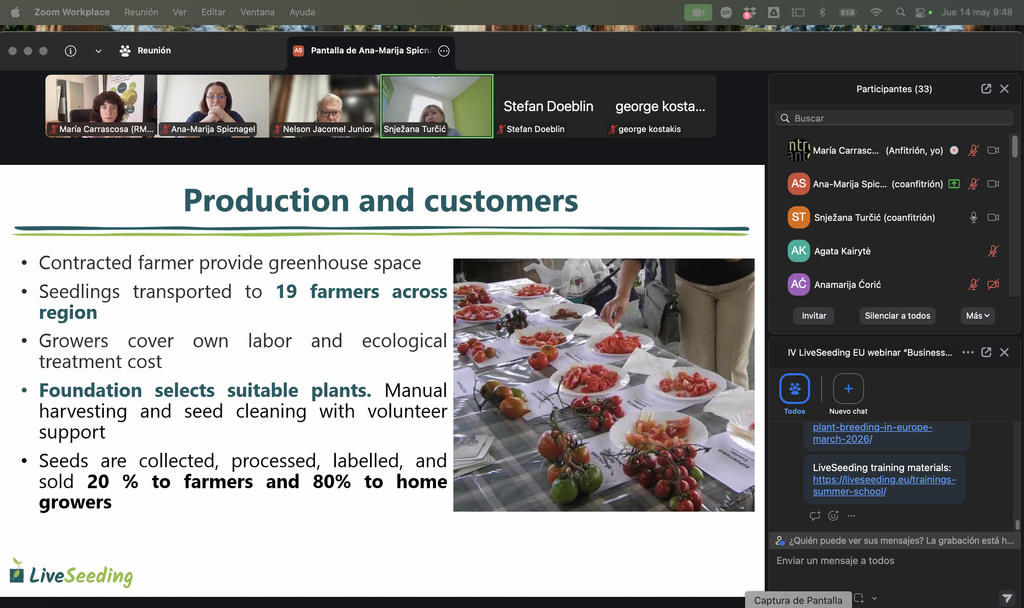
Second step: Turning a business idea into a clear action plan — the Business Model Canvas
Still led by Špičnagel, the second session introduced the Business Model Canvas (BMC), a one-page visual tool built around nine categories covering four pillars of a business: customers, offer, infrastructure and financial viability. Particular attention was given to how each block applies to the organic seed and breeding sector, with a worked example on a vegetable landrace.
Discussion highlighted several practical lessons:
- Business Model Canvas vs Business Plan: the BMC is a fast, one-page way to test and visualise a business idea from scratch; the Business Plan is a much longer document—often around 60 pages—built once the idea is clearer, and typically requires professional support to prepare. Both are living documents that need regular updating.
- Of the nine BMC blocks, value proposition, revenue streams and customer segments were flagged as the most decisive: if an initiative offers the same as everyone else, price becomes the only differentiator — hence the need for a clear, defensible revenue model.
- On key partners, participants discussed the importance of building a network of research institutions, organic networks, certification bodies, other seed producers, EU funding consortiums, and advisory services. One reflection from participants: initiatives benefit from embedding themselves within — or helping create — the organic sector.
- On key resources, participants discussed human, financial, and physical resources, and suggested including experimental field plots to test varieties and commercial staff who can listen directly to customer demand.
- On revenue streams, the importance of not depending on a single income source was stressed: combining short-term and long-term revenues helps mitigate risk, and EU projects were noted as a particularly valuable long-term resource due to their sustained funding period.
Shared materials
- Second step: Turning a business idea into a clear action plan – Business Model Canvas
- LiveSeeding Business tools (BB and BMC)
Session 2: Business Plans (Day 2)
Third step: Business Planning — How to Get Started
The second day opened with Snježana Turčić and Ana-Marija Špičnagel (IPS Konzalting) introducing the Business Plan: a written document analysing the investment, projected results, and risk scenarios of a business, designed to reduce risk and support decision-making. A sound business plan is market-oriented rather than centred on internal production capacity and includes a realistic, convincing development vision; market and competition analysis; financing sources; and financial projections. Key financial concepts covered included CAPEX and OPEX, the break-even point, and revenue stream mapping.
To ground the tool in practice, two anonymised real-life business plans were shared:
- A vegetable seed association case (tomato as the flagship product) showed a financially resilient, community-based seed-saving initiative with a diversified — though subsidy-dependent — income mix. The analysis showed that while subsidies significantly strengthen overall financial stability, tomato seed production itself is profitable on its own; its main constraint is a distribution and visibility gap rather than a production one, with online and international sales identified as the most promising short-term growth lever.
- A durum wheat case, from a non-profit organic breeding initiative, illustrated how sensitivity analysis across multiple scenarios can reveal that a trading model can be operationally sound while remaining highly vulnerable to the cost of financing capital investment without subsidy support. The recommendation was to prioritise production scale-up and cost control, and to time any major investment to periods when subsidy support and sufficient production volume are secured.
Discussion afterwards touched on the importance of the break-even point, the risk of overly long payback periods (over ten years being considered excessive), the role of the business plan as a tool to approach banks for financing, and the need to plan realistically for difficult years, alongside marketing.
Shared materials
- Step 3: Business Planning – How to get started
- Business plan for farmers initiative – tomato
- Business plan for farmers initiative – durum wheat
Last step: How to finance your initiative — Funding Sources
The closing session, led by Mariateresa Lazzaro and Monika Messmer (FiBL Switzerland, LiveSeeding Scientific Co-coordinators) together with Ana-Marija Špičnagel, mapped the landscape of financing mechanisms available to organic plant breeding initiatives, drawing on LiveSeeding’s own analysis and on prior EU projects in the field (LIVESEED, Engagement.BioBreeding). Sources reviewed included farmer and consumer contributions, food processor and retailer support, private and philanthropic donations, public research funding (national and Horizon Europe), public start-up and investment support (including CAP Rural Development instruments and LEADER), pool-funding mechanisms, crowdfunding, value chain co-investment, and ethical investment — each with its own opportunities and limitations. A recurring message was that organic plant breeding requires long-term commitment, since developing a new cultivar takes 10 to 15 years, and diversified, blended funding — combining public, private and philanthropic sources — offers the most resilient path forward.
The session also included a short pitch-training exercise, in which volunteers practised presenting their initiative to a specific funder (bank or philanthropic organisation), with feedback from the speakers.
Shared materials
- Overview of financing sources of organic plant breeding
- Participation in EU projects: real-life experiences
- Joining forces to enable financing for Organic Plant Breeding
- Factsheet on Governance and financing strategies in Organic Breeding
Conclusions
Closing the two-day webinar, María Carrascosa thanked speakers and participants and highlighted that the sector faces, at the same time, a large and growing organic market and a still-small organic seed market that needs sustained financial and policy support to reach the 2036 target. She stressed several cross-cutting points: the conventional seed market remains the main competition; qualified labour, especially in rural areas, is hard to secure; the perception within the producing sector that organic seed quality still needs to improve; and regulatory hurdles such as the plant passport, which add real cost and complexity for small-scale initiatives. Carrascosa closed by inviting participants to the LiveSeeding Final Conference — “Change Seeds, Grow the Difference” — taking place on 10 June 2026 in Brussels, which will bring together project partners, stakeholders and policymakers to reflect on the project’s results and their relevance to achieving 100% organic seed use in Europe by 2036.
Recordings
| Previous EU webinar of the LiveSeeding Organic Seed and Breeding Entrepreneurship Training Centre – Entrepreneurship in the organic seeds and breeding sector. 13-14 December 2023. – Strategies for Marketing and Promoting Organic Seeds Locally and Effectively. 24-25 February 2025. – Governance and Finance Models for Organic Seeds and Plant Breeding in Europe. 10-11 March 2026. |