Researchers, policymakers and practitioners call for stronger policy alignment to unlock the potential of organic seed in Europe
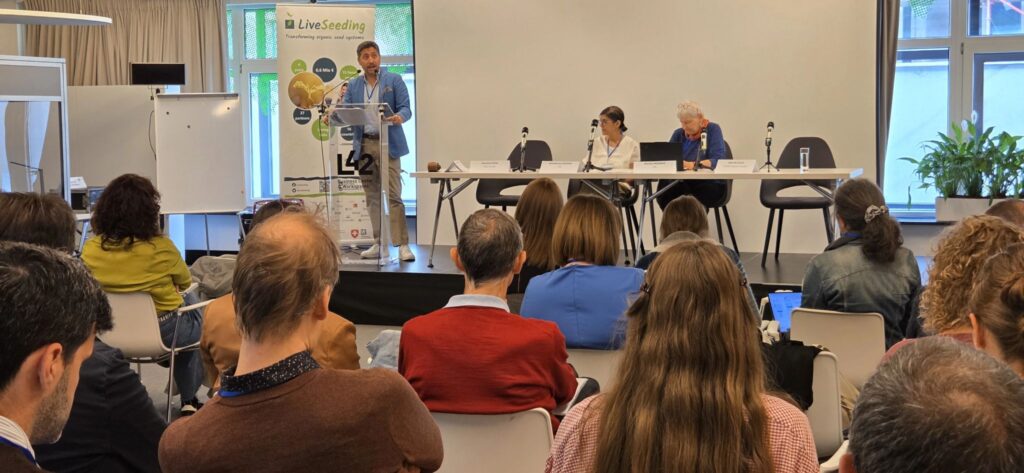
The LiveSeeding Final Conference brought together over 100 participants in Brussels to present four years of evidence on organic seed and plant breeding and discuss what EU policy needs to do next.
The LiveSeeding project concluded its four-year Innovation Action with a final conference held on 10 June 2026 at L42, Brussels. The event brought together researchers, organic seed producers and breeders, representatives of the European Commission, a Member of the European Parliament, and civil society organisations to take stock of the project’s results and chart a path forward for organic seed and plant breeding in Europe.
Towards 100% organic seed use: progress and gaps
The conference opened with an overview of the project’s scientific achievements, presented by LiveSeeding Scientific Coordinators Monika Messmer and Mariateresa Lazzaro (FiBL Switzerland), followed by a session on the current status of organic seed use across Europe.
Speakers including Freya Schäfer (FiBL Germany), Stéphanie Klaedtke (ITAB), and Judith De Roos-Blokland (Bejo) highlighted that progress towards 100% organic seed use is uneven across crop sectors and Member States, and depends on seed availability, seed health, and the effectiveness of national coordination mechanisms. National representatives from France (INAO) and Italy (CREA) presented practical tools including seed databases and supply-demand matching systems. Patrizia Pitton (DG AGRI, European Commission) outlined the next steps needed to improve harmonisation and support the gradual phase-out of derogations.
Breeding innovation, the role of living labs and cultivated biodiversity
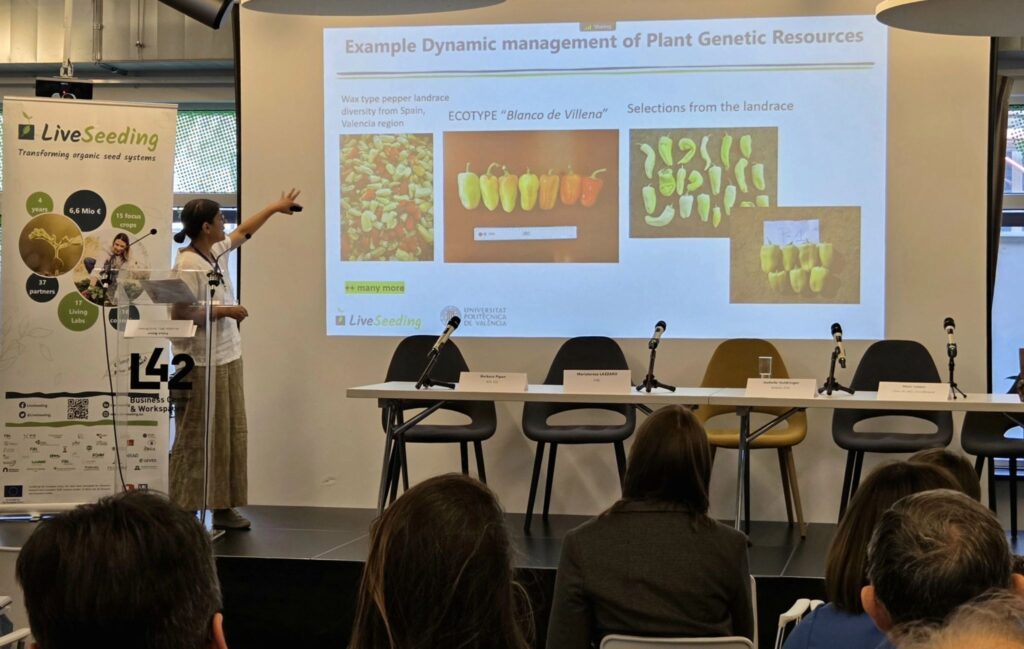
The afternoon opened with a session on dynamic management of plant genetic resources and participatory breeding. Mariateresa Lazzaro (FiBL) presented how Living Labs across Europe have connected breeding with local food systems and value chains. Isabelle Goldringer (INRAE) highlighted the role of organic heterogeneous material and composite cross populations in increasing resilience and local adaptation. Marc Lateur (CRA-W) introduced the work of the InnOBreed sister project on perennial crops and the European Collaborative Charter for Organic Fruit Breeding Network.
A dedicated session explored the role of municipalities in bringing cultivated biodiversity closer to citizens. María Carrascosa (Red de Municipios por la Agroecología) presented the Granollers Manifesto and the growing network of pioneer cities integrating cultivated biodiversity into local food policies. Federica Pacini (Municipality of Scandicci) and Véronique Chable (INRAE) shared experiences from long-term participatory approaches connecting local authorities, researchers, and farming communities. Francesca Gori (Rete Semi Rurali) presented findings on the key factors enabling successful Living Labs.
Policy perspectives and future directions
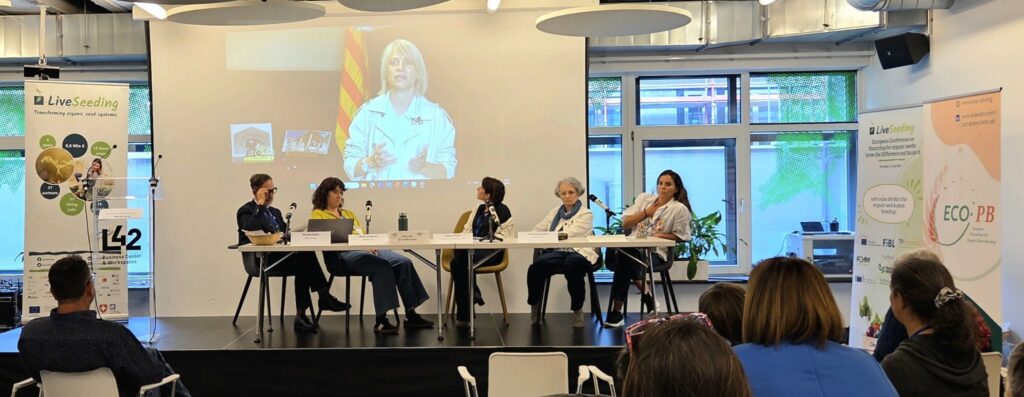
The closing panel discussion addressed what supportive policies are needed for organic seed and plant breeding to flourish. MEP Camilla Laureti (S&D, European Parliament) stressed the importance of concluding the PRM trilogue negotiations, calling for simpler certification procedures and broader support for all farms and rural areas. Eric Gall (IFOAM Organics Europe) highlighted the sector’s need for stability and predictability. Monika Messmer (FiBL) expressed hope that research efforts initiated through LiveSeeding will continue beyond the project’s end. Edwin Nuijten, newly elected President of ECO-PB, closed the conference by reminding participants that organic plant breeding must embrace diversity rather than a one-size-fits-all approach.
Exhibition and closing
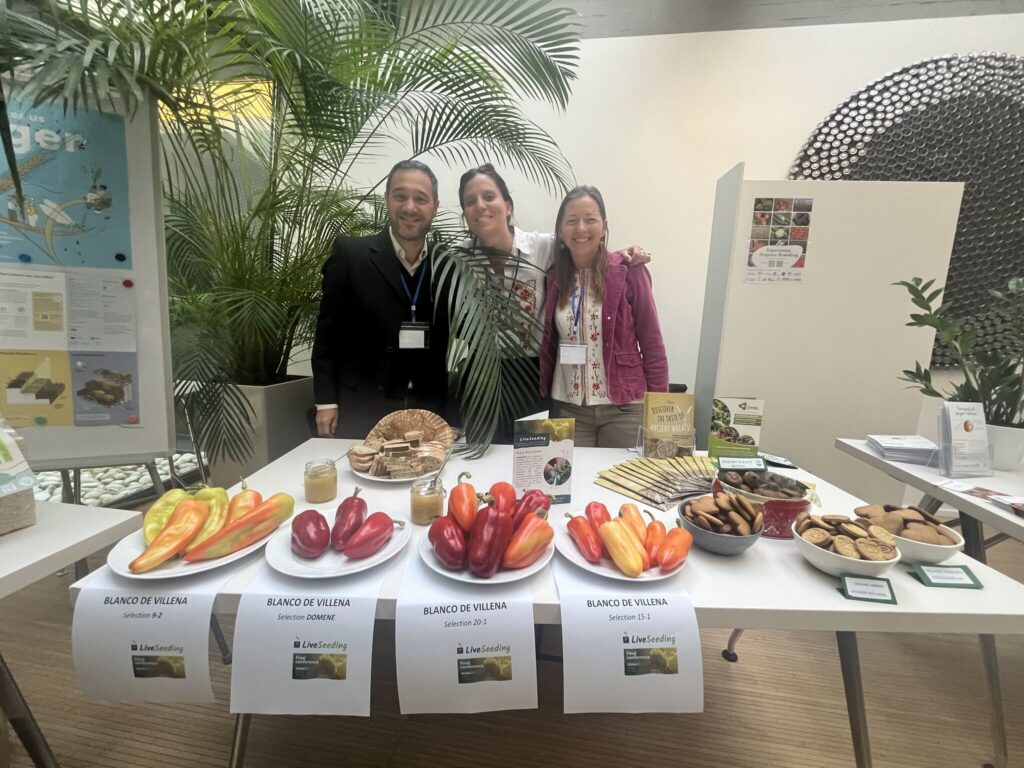
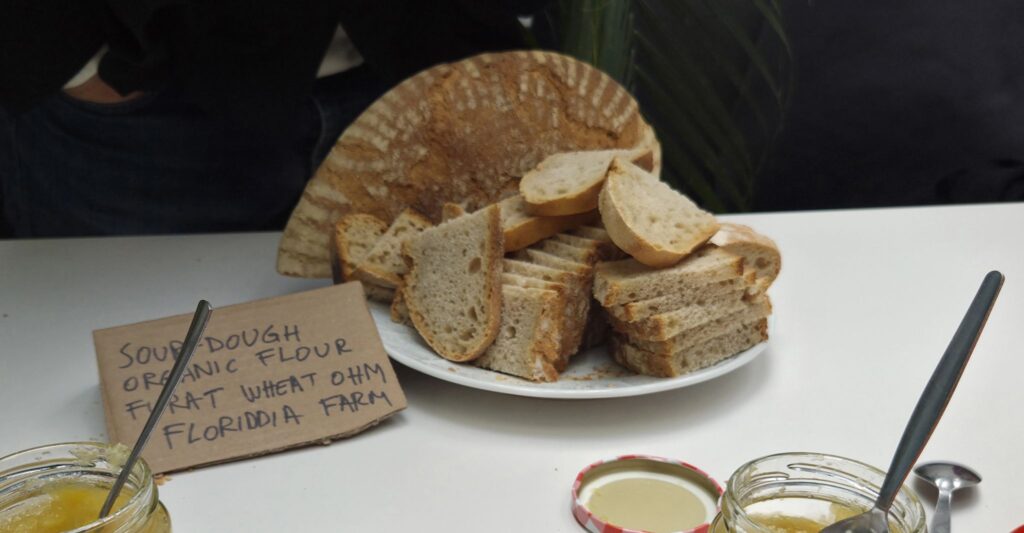
The conference concluded with an exhibition showcasing results from LiveSeeding Living Labs and partner initiatives, including products from Floriddia Farm, ancient wheat varieties from ÖMKi, participatory buckwheat breeding from INRAE and partners, radicchio and salad varieties from Smarties.bio, and rare vegetable varieties from ProSpecieRara and Sativa Rheinau. The day ended with a concert by Chorale Equinox.